

Dubai is a city of rapid acceleration, but its homes are increasingly looking backward to move forward.
After analyzing over 300 residential projects, we have noticed a shift.
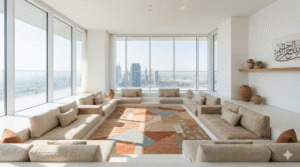
Homeowners in Jumeirah and the Hills are no longer asking for “Ultra-Modern” white boxes; instead, they are seeking a traditional interior style modernity cultural roots blend that reflects their heritage.
They want the soul of the past with the convenience of the future.
This is not just “decorating”; it is Transitional Architecture.
It is the engineering challenge of integrating high-tech cooling and smart lighting into spaces that feel historically grounded.
As a veteran interior design company in Dubai, NAK Interior specializes in this delicate balance.
We don’t just hang a lantern; we re-engineer the space to ensure the lantern works with your Lutron automation system.
The Transitional Formula
Heritage Aesthetics + Modern Ergonomics + Smart Utility = Timeless Living
- The Mistake: Using heavy, dark traditional drapes that block 100% of natural light.
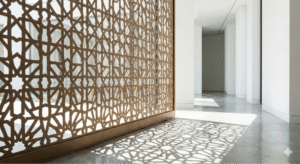
- The Fix: Using “Mashrabiya” patterns on laser-cut metal screens to filter light without killing it.
- The Result: A space that respects culture but functions for 2026 & beyond
Cultural Elements that Define Tradition
To engineer a space that feels “authentic,” we must first keep the fundamentals in consideration.
- Cultural Elements are the specific data points of a society’s identity. Its art, beliefs, and social habits that manifest physically in the built environment.
- Tradition is simply the repetitive execution of these protocols over multiple generations to solve specific environmental or social problems.
But where does this tradition begin? It begins with the logic of the land itself.
Before there were architects, there was the climate. The way people built to survive the desert sun became the foundation for what we now call “style.” This intersection of survival and habit is known as Vernacular Architecture.
Vernacular Architecture refers to design based on local needs, availability of construction materials, and reflecting local traditions.
In the UAE, “Tradition” is not just a style; it is a survival mechanism against the climate.
Interior style professionals analyze three core technical elements:
- Arches & Geometry: Historically, arches distributed structural weight. Today, interior stylists use them as “Visual Framing” devices to soften the harsh rectangular lines of modern concrete villas.
- Mashrabiya (The Original AC): Before electricity, these lattice screens accelerated airflow to cool the interior.
- Warm Palettes: Terracotta and Sand tones were used because they didn’t show desert dust.
Engineer’s Note: In modern interior renovation services, we often replicate the look of a wind tower (Barjeel) but use it as a concealment shaft for modern VRF air conditioning ducts.
Modern Enhancements for Functionality
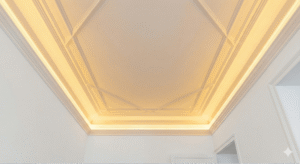
Modern enhancement and smart integration are the thoughtful concealment of modern technology within traditional architectural forms.
It is the practice of designing “invisible technology.” Where internet-connected devices enhance your daily life without cluttering your visual environment.
The challenge with traditional design is that it can feel dark and heavy.
Historically, thick stone walls and small windows were used for insulation, but they often led to poorly lit interiors.
Interior design experts fix this with modern physics.
1. Smart Lighting Profiles
Traditional lighting often relies on a single, warm-colored bulb. Interior masters use Layered Lighting controlled by a central hub to transform the mood.
| Circadian Lighting | Invisible Fixtures |
| Your lights automatically transition from bright, cool tones (5000K) during the day to help you focus, to warm, golden hues (2700K) in the evening to prepare you for sleep. | An expert interior stylist hides high-output LED strips within traditional ceiling cornices (Cove Lighting) to bounce light off the ceiling, making the room feel taller and lighter. |
2. Intelligent Climate Control
In older villas, maintaining a consistent temperature is an engineering battle.
| Automated Shades | Zoned Cooling |
| Interior stylist integrates motorized rollers within traditional window valances.
Sensors detect the intensity of the Dubai sun and automatically close the blinds to reduce the heat load before your AC even kicks in. |
Instead of cooling the whole house, smart thermostats learn your habits, prioritizing airflow to the rooms you actually occupy. |
3. Multifunctional Heritage
We use technology to give a single traditional space multiple identities.
| The Hidden Cinema | Interactive Surfaces |
| A motorized projector screen can be concealed inside a hand-carved wooden header, descending only when it’s movie time. | Interior styling pros use smart mirrors in bathrooms that serve as both a traditional decorative element and a digital display for your morning news and weather. |
The Efficiency Impact:
- Integrating these systems isn’t just about luxury; it’s about asset performance.
| Smart Feature | Traditional Limitation | Modern Solution | Energy Impact |
| Lighting | Static & Heavy | Automated Dimming & Kelvin Shifts | Up to 30% reduction in power use. |
| Climate | Manual & Inefficient | Sensor-driven VRF Control | 15–20% savings on DEWA bills. |
| Space | Fixed Use | Modular & Tech-Enabled Rooms | 100% utility of every square foot. |
Achieving Balance: Heritage Meets Minimalism
Before we can merge two eras, we must understand the mechanical tension between them.
- Balance is the state of visual equilibrium in a room, where the “weight” of objects is distributed so that no single area feels overwhelming or neglected.
- Minimalism is a design philosophy rooted in the “less is more” principle, emphasizing essential forms, clean lines, and the removal of unnecessary ornamentation to foster spatial clarity.
When you combine the intricate patterns of heritage with the stripped-back nature of minimalism, you aren’t just mixing styles. You are managing how the eye moves across the space.
This movement is dictated by a concept our engineers call “Visual Weight.”
Visual Weight is the perceived heaviness of an element in a room. It is not about the literal kilograms of a sofa, but about how much attention it grabs.
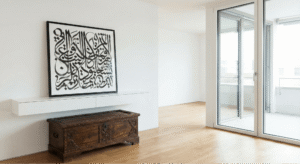
In our experience with over 300 site handovers, we’ve found that a “heavy” traditional piece (like an ornate dark wood chest) can comfortably live in a “light” minimalist room as long as its presence is calculated.
The Physics of Visual Attention
To achieve this balance, we manipulate the attributes of each object to control its weight:
- Color & Shade: Dark colors (Navy, Walnut, Black) carry more visual weight than light colors (Beige, White, Pastels).
- Texture & Complexity: A rough, hand-carved surface feels “heavier” to the eye than a smooth, glass partition.
- Size & Scale: Naturally, larger objects anchor the room, but a small, brightly colored traditional rug can have the same visual weight as a large, neutral-toned sectional.
The Contrast Strategy
Expert interior stylists in Dubai use the “Anchor and Air” method to prevent heritage pieces from making a space feel dated or cluttered.
| Element Type | Visual Weight Attribute | Role in the Space |
| Traditional Anchor | High (Ornate, Dark, Textured) | Acts as the focal point; provides “soul” and history. |
| Minimalist Framework | Low (Clean lines, Neutral, Glass) | Provides “breathing room” and modern utility. |
| Connecting Bridge | Balanced (Natural Wood, Linen) | Ties both styles together through shared organic textures. |
Bespoke Joinery & Furniture as Identity Carriers
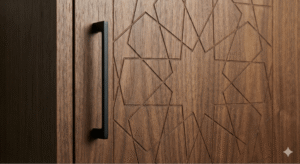
Joinery Tolerance is the allowable limit of variation in wood dimensions due to humidity expansion.
In Dubai, humidity can hit 90%. Solid wood expands and cracks.
This is why “Authentic” furniture often fails in modern AC environments.
We use custom wood furniture in Dubai to solve this:
- The Look: We use a 3mm veneer of authentic Walnut or Teak.
- The Core: We bond it to Marine Grade Plywood.
Material Performance Chart:
| Feature | Traditional Method (Solid Wood) | Modern Engineering (Veneer/Ply) | Why We Use It |
| Stability | Low (Warps in AC) | High (Dimensionally Stable) | Doors won’t stick in summer. |
| Cost | High (AED 800+/sqm) | Medium (AED 350+/sqm) | Budget efficiency. |
| Finish | Hand Polish (Fades) | PU Lacquer (UV Resistant) | Resists sun damage near windows. |
This engineering approach preserves the soul of tradition but ensures the longevity of the asset.
Final Styling: Art, Fabrics & Storytelling
Curated Narrative is the strategic placement of objects to tell a specific cultural story.
Do not clutter. Selectivity is key.
- Antique Pieces: Use one large chest instead of ten small trinkets.
- Calligraphy: Modern art pieces using “Thuluth” script in metallic gold on a black canvas bridge the gap perfectly.
- Textiles: We source fabrics with “Sadu” weaving patterns but printed on modern, stain-resistant polyester blends for durability.
Conclusion
Tradition is not about living in a museum. It is about respecting the past while living comfortably in the present.
The secret is not in the decoration; it is in the Engineering of Materials.
When you combine Marine Plywood joinery with Islamic geometry, you get a home that feels ancient but works like a machine.
Ready to modernize your heritage?
Contact our interior design company in Dubai that speaks both languages.
Questions That Many Home & Business Space Owners Ask Frequently
Can traditional interiors look modern?
Yes. We call this “Transitional Design.” The trick is to strip away the clutter. Use traditional patterns (like a geometric rug) but keep the furniture lines clean and simple.
Is custom furniture necessary for heritage style?
Often, yes. Modern furniture stores rarely sell authentic Majlis dimensions (low seating, deep depth). Custom wood furniture in Dubai allows us to build the traditional shape, but with modern, high-resilience foam for comfort.
Which colors represent regional culture?
Think of the landscape. Terracotta (Red Sands), Warm Beige (Limestone), and Turquoise (The Gulf). We use these as accent colors against a modern neutral background.
Does traditional design cost more?
It can, because of the labor intensity. Hand-carved wood is expensive. However, using CNC-cutting technology (machines that carve wood based on a digital file) reduces the cost of “traditional” detailing by 40%.
How do I light a traditional room without it looking dark?
Avoid relying on a single central chandelier. Use “Layered Lighting.” Combine the decorative chandelier with hidden LED cove lighting and focused spotlights to brighten the corners and highlight the architecture.
Can I mix metal finishes?
Yes. In fact, it adds depth. You can mix the “Old Gold” of traditional accessories with the “Matte Black” of modern door handles. The contrast makes the gold pop.