

Renovating a property in Dubai isn’t just about picking colors; it’s a complex engineering challenge involving structural loads, MEP (Mechanical, Electrical, Plumbing) integrity, and strict adherence to building codes.
Whether you are upgrading a villa in the Hills or fitting out an office in Business Bay, the success of the project hinges on one variable:
- Data Transfer
In our industry, “communication” isn’t about long chats over coffee. It is about accurately transferring your functional requirements and aesthetic parameters to the technical team.
When communication is clear, we can optimize spatial flow and ensure material durability. When it is vague, you risk variation orders and delays.
As a leading interior design company in Dubai, NAK Interior bridges the gap between your abstract ideas and the concrete realities of construction. We turn “I want a nice kitchen” into a technical drawing specifying moisture-resistant MDF cabinets, ergonomic work triangles, and precise lumen output for task lighting.
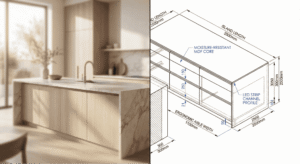
This guide outlines exactly how to convey your requirements to an interior designer & ensure your interior design and fit-out company in Dubai delivers a solution that works as well as it looks.
Identify Your Style Preferences Early
Before we look at a single floor plan, we need to establish the visual language of the project. However, simply saying “Modern” or “Classic” is often insufficient from a technical design perspective. “Modern” can mean the stark minimalism of a JBR penthouse or the warm, mid-century modern aesthetic popular in the Springs.
Define the Design Vocabulary
To an a, your style preference dictates material selection and joinery tolerances.
- Minimalist: Requires high-precision joinery with hidden hardware and handle-less profiles.
- Industrial: Involves exposed MEP elements, requiring organized containment systems and raw finishes like micro-topping.
- Traditional/Arabic: Often involves intricate Computer Numerical Control (CNC)-cut mashrabiya patterns and heavier load-bearing decorative elements.
The Research Phase
Don’t rely on memory. Use visual data points.
- Platform Audit:
Scour Pinterest and Instagram, but look closer. Don’t just look at the colors; look at the lighting profiles and furniture scale.
- Local Context:
Look for examples specifically in the UAE. A design that works in a wooden house in Europe may not be feasible for a concrete structure in Dubai Marina due to humidity and AC constraints.
- Service Specifics:
If you are looking for bathroom interior design in Dubai, look for layouts that handle wet-area zoning effectively. For commercial interior design in Dubai, focus on acoustic treatments and workflow layouts.
Engineer’s Note:
The earlier you define the style, the sooner we can determine the procurement feasibility of materials.
Some specific veneers or marble slabs have lead times of 8-12 weeks.
Create a Mood Board or Visual Brief
A visual brief is the most efficient way to reduce the margin of error in design interpretation. It converts subjective feelings into objective data that our procurement and design teams can act on.
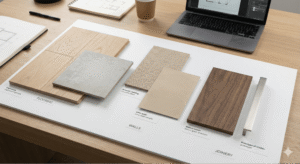
Why We Need Visual Data
Verbal descriptions are subjective. “Bright” to you might mean 3000K warm white; to us, it might mean 6000K cool daylight. A mood board calibrates our sensors.
Structuring Your Visual Brief
Organize your images into specific categories rather than a chaotic collage:
- Flooring Profiles: Do you prefer the thermal properties of engineered wood or the durability of porcelain tiles?
- Wall Finishes: Are we looking at standard emulsion, breathable lime wash, or acoustic cladding?
- Lighting Mood: Show us the shadow play you want. This dictates our electrical plan and circuit loads.
- Joinery & Millwork: This is critical for joinery work in Dubai. Show us the edge details, the grain direction, and the hardware finish.
Before vs. After
If you have photos of your current space, annotate them. Circle the areas that cause frustration, like a dark corner or a bottleneck in the hallway. This allows us to apply bespoke joinery in Dubai solutions to solve specific spatial problems.
Explain Your Lifestyle & Functional Needs
This is where we move from “Aesthetics” to “Ergonomics.” As a fit-out specialist, I am less interested in what you want the room to look like and more interested in how you need the room to perform. We treat your home or office as an Entity with specific functional Attributes.
Residential: The Ergonomic Flow
If we are discussing a kitchen renovation in Dubai, we need to know your operational habits:
| Occupancy Load: | How many people cook simultaneously?
This determines the aisle width (minimum 110cm for two cooks). |
| Storage Velocity: | Do you buy groceries daily or monthly?
This dictates the ratio of pantry space to countertop space. |
| Appliance Specs: | An American-style fridge requires a different cavity depth and ventilation clearance than a standard European model. |
Commercial: Efficiency Metrics
For a warehouse office conversion in Dubai or a corporate space, the focus shifts to productivity:
| Acoustic Separation: | Do you need soundproof meeting pods? |
| Data & Power: | Where are the workstations located relative to the floor boxes?
Avoiding trailing cables is a safety and aesthetic priority. |
By explaining your daily routine, you allow us to deploy interior renovation services that actually solve problems.
Talk Budget & Timeline Openly
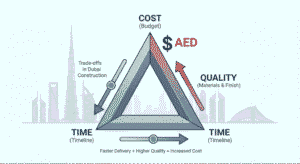
Transparency regarding budget and timeline is the foundation of a successful project. In construction, we operate on the Iron Triangle:
- Cost
- Quality
- Time
You cannot maximize all three simultaneously without compromise; if you want it fast and high-quality, the cost increases. If you want it cheap and fast, quality suffers.
The Budget Reality
A professional interior contractor in Dubai will not judge your budget; we will engineer the best solution within it. We start by breaking down where your money actually goes.
Typical Budget Allocation:
- 40–45% Materials: This covers tangible items like porcelain tiles, joinery, sanitary ware, and lighting fixtures.
- 30–35% Skilled Labor: Specialized technicians for MEP, carpentry, and masonry (not general helpers).
- 20–25% Logistics & Supervision: Waste disposal (skip fees), transport, and site engineering management.
Hidden Costs: Government & Building Fees
Before we lay a single brick, there are administrative costs in Dubai that you must factor into your liquidity planning. These are often overlooked by homeowners but are mandatory for compliance.
| Fee Type | Estimated Cost (AED) | Notes |
| Developer NOC | 1,000 – 5,000 | Non-refundable. Required by Emaar, Nakheel, DP, etc. |
| Security Deposit | 2,000 – 5,000 | Refundable. Held by Building Management for common area damages. |
| Municipality Permit | 500 – 2,000 | Decor permits from DM or Trakhees (depending on zone). |
Ballpark Costing
To help you plan, here are the current market ranges for fit-out services in Dubai. These figures allow us to align your expectations with engineering realities.
| Service Category | Standard Spec | Premium / High-Spec | What Drives the Cost? |
| Commercial Fit-Out | AED 150 – 250 / sq. ft. | AED 300 – 500+ / sq. ft. | Acoustic glazing, open-ceiling MEP work, and custom joinery. |
| Apartment Renovation | AED 35k – 60k (Studio) | AED 75k – 120k (1-Bed) | Extent of demolition, floor leveling, and electrical re-wiring. |
| Bathroom Fit-Out | AED 25,000 – 35,000 | AED 45,000 – 80,000+ | Sanitary brands (e.g., Gessi/Kohler) and tanking systems. |
Timeline & Approvals
In Dubai, timelines are dictated by the Approval Phase before the Execution Phase. We cannot start noise works until the paper trail is complete.
- The Approval Buffer: You must factor in 2–3 weeks before the start date for paperwork.
- Step 1: Developer NOC (5–10 working days).
- Step 2: Dubai Municipality/Trakhees Permit (2–5 working days).
- The Execution Phase: A standard apartment renovation typically requires 6 weeks of physical work, assuming no major structural changes.
Engineer’s Advice:
- Be open about your lease end date or move-in deadline.
- This allows us to “backwards-plan” the critical path to ensure we hit the milestone.
Be Clear About “Must-Haves” vs. “Nice-to-Haves”
Value Engineering (VE) is a standard part of our process. If the initial design exceeds the budget, we need to know what elements are non-negotiable (Must-Haves) and what can be substituted (Nice-to-Haves).
The Priority Matrix
- Must-Haves (Functional Integrity):
- MEP Upgrades: Upgrading old wiring or plumbing is non-negotiable for safety.
- Waterproofing: In bathrooms, industrial-grade tanking is a must to prevent leaks.
- Storage Volume: If you need 5 cubic meters of storage, we cannot reduce this without affecting the utility.
- Nice-to-Haves (Aesthetic Variables):
- Material Grades: We can swap a natural Italian marble for a high-density, moisture-resistant quartz composite. It looks similar, costs less, and is often more durable.
- Brand Specs: We can swap designer light fixtures for high-quality architectural lighting with the same CRI (Color Rendering Index) but a lower price tag.
For example, in a modular kitchen in Dubai, the “Must-Have” might be soft-close BLUM hinges (for durability), while the “Nice-to-Have” might be a specific high-gloss lacquer finish, which can be swapped for a durable laminate.
Review 3D Concepts & Material Samples Carefully
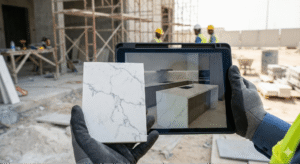
Once we present the design, do not just glance at the 3D renders. Analyze them. The 3D render is a simulation of the final product, including lighting, temperatures, and spatial volume.
Assessing the Layout
- Flow Check:
Trace your finger on the floor plan. Is there a clear path from the entrance to the kitchen? Is the bathroom door visible from the living room (a negative feature)?
- Volume Check:
Look at the ceiling heights. If we are adding a false ceiling for AC ducting, how does that affect the room height?
Material Sample Board
Digital screens lie. You must physically touch the materials.
- Haptic Feedback: Feel the texture of the wood veneer. Is it rough or smooth?
- Light Interaction: How does the fabric look under warm light vs. daylight?
- Durability Test: Scratch the sample. Splash water on it.
- Joinery Quality: For custom wood furniture in Dubai, check the edge banding. It should be seamless to prevent moisture ingress, which is critical in Dubai’s humid months.
As a specialized joinery company in the UAE, we provide samples that represent the exact density and finish of the final product. Your interior design fit-out company in Dubai handles the procurement based on these approved samples.
Maintain Structured Communication During Execution
Once the hammer hits the wall, the project moves to the Site Execution phase. Frequent, unstructured communication (like WhatsApping random thoughts at 10 PM) can confuse. Structured communication ensures the site team follows the approved drawings.
The Feedback Loop
- Weekly Site Visits: We schedule these to review progress against milestones.
- Snagging Lists: Instead of pointing out issues one by one, compile a list. This allows the team to tackle rectifications efficiently.
- Change Orders: If you decide to move a socket after the walls are chased, this is a Variation Order. It has cost and time implications.
Single Point of Contact
Rely on your Project Manager. They coordinate the masons, electricians, and carpenters. A single interior design and fit-out company in Dubai simplifies the headache by managing these sub-teams for you. Whether it’s interior fit-out services for an office or a home, the chain of command protects the project timeline.
See more about our commercial capabilities here: commercial interior fit-out companies.
Conclusion
Renovating is a partnership. The best results come when your vision is backed by clear functional requirements, and our engineering expertise is given the freedom to execute them. Clarity equals precision.
At NAK Interior, we don’t just decorate; we solve spatial and technical problems. We are the interior design company that Dubai homeowners trust because we speak the language of construction fluently.
Ready to transform your space with engineering precision?
Let’s look at your floor plan. Contact us today for a feasibility assessment.
Solving Your Doubts Before We Start
What details should I provide first during a consultation?
Bring your floor plan (with dimensions if possible), photos of the current space, and a clear statement of your budget cap. Also, inform us if the property is under a mortgage or if there are specific building management restrictions (e.g., working hours).
How many mood boards do designers need?
One consolidated board is better than ten conflicting ones. Focus on quality over quantity. Select 5-10 images that perfectly capture the “vibe” and specific details (flooring, lighting, joinery) you want.
Can I make changes after execution has started?
Technically, yes, but it is not recommended. Changes during the execution phase (Variation Orders) will almost always incur extra costs for materials and labor, and will definitely delay the handover date.
What if my style preferences evolve during the project?
This is why the “Design Phase” exists. We do not start cutting wood until you sign off on the 3D design. Once materials are ordered (especially custom joinery or imported tiles), changing style is costly.
Do designers also handle materials and contractors?
Yes. NAK Interior is a full-service interior design and fit-out company. We handle everything from the 3D design and DEWA approvals to the procurement of materials, construction, and final cleaning. You deal with one entity, not five different freelancers.