


After auditing over 300 homes and offices across the UAE. From the waterfronts of Dubai Marina to the family villas of Ajman. We have found a consistent pattern.
The number one regret homeowners have is not the price they paid, but the materials they chose.
“The floor looks dirty even after cleaning,” or “The wall color feels too dark at night.”
These are not matters of taste; they are matters of physics and engineering.
Choosing materials is not just about “what looks good.”
It is about balancing Light Reflectance Value (LRV), Abrasion Resistance, and Thermal Comfort.
As a leading interior design company in Dubai, we don’t just pick colors; we engineer environments that survive the harsh local climate while looking pristine.
The Selection Formula
Usage Intensity (Traffic) + Light Availability (Lux) = Material Choice
- The Golden Rule: Never use porous stone (like Travertine) in a kids’ bathroom.
- The Visual Hack: Lighter colors (High LRV) reduce the need for artificial cooling by reflecting heat.
- The Reality: In Dubai, dust is inevitable. High-gloss floors highlight dust; matte finishes hide it.
Color Psychology & Mood Setting
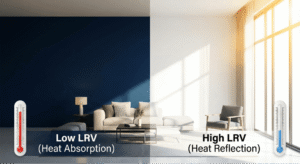
Color Psychology is the study of how different hues affect human behavior and perception.
This is not a modern trend; it is rooted in the work of Carl Jung, the Swiss psychiatrist who famously stated that “colors are the mother tongue of the subconscious.”
He utilized color therapy to help patients express trauma and regulate emotions. In interior design, color acts as “visual data” that tells the brain how to feel in a space, triggering biological responses like increased appetite (red) or relaxation (blue).
But in the UAE, we must also consider the Heat Index.
Dark colors absorb heat; light colors reflect it. This isn’t just about feeling “warm”; it’s about physics.
A dark wall facing the Dubai sun acts like a thermal battery, soaking up heat all day and radiating it back at night, forcing your AC to work harder.
We measure this using LRV (Light Reflectance Value).
Here is how different colors impact your room’s temperature profile:
| Color Family | Heat Index (Absorption) | LRV (Reflection) | Best Use Case in Dubai |
| Pure White | Lowest (Coolest) | 85–90% | South-facing rooms with direct sun. |
| Beige / Cream | Low | 70–80% | The standard for villas hides dust well. |
| Light Grey | Medium | 50–60% | Modern living areas; balances cool/warm. |
| Navy / Black | Highest (Hottest) | 5–10% | Avoid on sun-facing walls. Use as accent only. |
- Neutrals: The “Engineering Choice.” They maximize light distribution and reduce cooling loads.
- Blues & Greens: Biophilic colors that lower heart rates, perfect for bathroom interior design in Dubai.
- Reds & Oranges: High-energy. Use sparingly in commercial break rooms, never in bedrooms.
Engineer’s Tip:
- Always test paint colors on site.
- The sun in Sharjah hits differently than the shadowed alleys of JBR.
- A “Warm White” can look yellow in the afternoon sun.
Material Selection Based on Usage

Material Durability is the measure of a surface’s ability to withstand wear, pressure, or damage.
An interior design expert classifies materials based on the “Traffic Load” of the area. For example, a busy corridor in a Dubai office faces abrasive dust and constant footfall (High Load), whereas a guest bedroom in a private villa sees minimal stress (Low Load).
You cannot use the same wood flooring in a commercial lobby as you do in a master bedroom.
We use the PEI Rating (Porcelain Enamel Institute) to grade tiles:
| PEI Rating | Usage Class | Recommended Area |
| Class 1 | Very Low Traffic | Wall tiling only (No foot traffic). |
| Class 3 | Moderate Traffic | Residential bathrooms and bedrooms. |
| Class 5 | Heavy Traffic | Commercial interior design Dubai (Offices, Malls). |
The Custom Solution:
- Store-bought furniture often uses low-density particle board that warps in humidity.
- For long-term value, we recommend custom furniture in Dubai using Marine-grade plywood.
- This is non-negotiable for clients in humid areas like coastal Ajman or the Palm Jumeirah.
Lighting & Texture Interaction
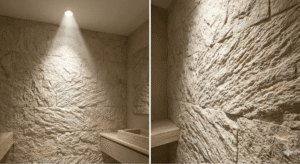
Texture is the surface quality of a material (rough, smooth, matte, gloss) that dictates how it interacts with light.
Lighting is not just about the bulb; it is about what the bulb hits.
- Gloss Finishes: High reflectivity. They make small spaces look bigger but act as a “fingerprint magnet.”
- Matte/Honed Finishes: Low reflectivity. They absorb light, creating a cozy, sophisticated mood and hiding dust effectively.
The Shadow Play:
- In a bathroom interior design in Dubai, we often use textured stone tiles.
- When you place a “Grazer Light” (a spotlight aimed down the wall).
- The texture catches the shadow, adding depth without adding cost.
Cultural Relevance & Aesthetic Identity
Aesthetic Identity is the alignment of the interior design with the cultural or brand values of the occupant.
We serve a diverse market, from local Emirati families in Sharjah to multinational HQs in DIFC.
The “One Size Fits All” approach fails here.
- Residential: Many of our clients prefer a blend of modern minimalism with traditional warmth. Incorporating Majlis-style seating layouts within a modern architectural shell.
- Commercial: For commercial interior design in Dubai, the design must act as a 3D billboard for the brand.
If you are a tech startup, we use polished concrete and glass (Transparency). If you are a law firm, we use walnut veneers and sound-absorbing carpets (Authority).
Sustainability & Quality Checkpoints
Sustainable Design in the UAE context is not just about using recycled paper; it is primarily about Durability.
The most unsustainable thing you can do is replace your floor every two years because it fails to handle the climate.
According to EcoMENA, 70% of the total solid waste generated in the UAE comes from construction and demolition debris.
Every time you replace a warped cabinet or a cracked tile, you are adding to this mountain. We fight this by engineering longevity into your specifications.
Quality Checkpoints for a 10-Year Lifecycle:
- VOC Content (Volatile Organic Compounds): Low-VOC paints improve indoor air quality, which is non-negotiable for Dubai’s airtight, AC-dependent environments.
- Origin of Stone: Is the marble sealed properly? Porous stone absorbs coffee spills instantly.
- Fabric Rub Count: For sofas, we look for fabrics with a “Martindale Cycle” of 30,000+ rubs. If it can’t survive the lab, it won’t survive your living room.
Whether you are in Downtown Dubai or a villa in Sharjah, the heat and AC cycles test every material. Quality is your only defense against degradation.
Conclusion
The right material palette is not an accident. It is a calculated decision based on light, traffic, and physics.
When you choose the right specs, your home doesn’t just look better; it performs better. It stays cooler, cleans easier, and lasts longer.
Do not guess with your investment. Partner with a technical interior design company in Dubai to get the engineering right.
Ready to select materials that last? Let’s bring sample boards to your site. Whether you are in Dubai, Sharjah, or Ajman, you can contact us today for:
Common Questions & Practical Answers
Which colors make rooms feel bigger?
High LRV colors (Light Reflectance Value). Whites, off-whites, and cool light greys reflect more light, pushing the visual walls back. Dark colors absorb light, making the room feel tighter (which is good for coziness, bad for size).
How to choose bathroom-safe materials?
Look for the “R-Rating” (Slip Resistance). For wet areas like showers, you need a minimum of R10 or R11 anti-slip tiles. Never use polished marble on a shower floor; it is a safety hazard.
Do commercial spaces follow branding rules?
Strictly. In commercial interior design, the color palette must match the brand guidelines (Pantone codes). However, we adapt them. If your brand color is bright red, we use it as an accent (cushions, artwork), not as the main wall color, to avoid visual fatigue.
Is it expensive to use custom furniture?
Initially, it costs about 20-30% more than IKEA-style ready-made furniture. However, custom joinery uses solid wood/plywood and maximizes vertical storage (floor to ceiling), which adds tangible value to the property and lasts 10+ years longer.