


Cost planning is the engineering of your financial resources.
It is the essential first step that ensures your renovation project finishes on time and within your means.
Without a solid financial plan, even the most beautiful design can become a stressful burden.
By working with an experienced interior design company in Dubai, you can align your available capital with realistic timelines and high-quality design goals.
The 30-Second Logic: The Renovation Formula
Scope (Needs) + Specs (Wants) + The “Dubai Factor” (Permits) = Real Budget
- The Heavy Lifters: Kitchens & Bathrooms will consume ~60% of your capital.
- The Invisible Cost: Have you reserved 15% for Dubai Municipality fees, NOCs, and logistics?
- The Golden Rule: Never accept a “Lump Sum.” If it’s not in the BOQ (Bill of Quantities), you are paying for it twice.
Interior Design Budgeting

Budgeting is the process of forecasting the total financial requirement of a project before execution begins.
It is not just about guessing the price of a sofa; it is about calculating the cost of complexity.
To help you ground your expectations, here is the current market baseline for high-quality execution in Dubai:
| Project Type | Estimated Budget (AED) | Scope Inclusions |
| Full 1-Bedroom Apartment | 75,000 – 120,000 | Complete turnaround including demolition and MEP works. |
| Standard Bathroom | Starts from 25,000 | Proper tanking (waterproofing) and tiling. |
| Kitchen Overhaul | At least 35,000 | Durable joinery and stone countertops. |
In Dubai, many homeowners are surprised by how quickly costs accumulate.
A project is never just “buying materials.”
It includes design fees, municipal approvals, skilled labor, logistics, and contingency funds.
For example, a kitchen renovation in Dubai involves plumbing, gas lines, cabinetry, and heavy stone work.
Similarly, commercial interior design in Dubai requires strict adherence to Civil Defense codes, which impacts the cost of materials.
Our goal is simple: to forecast these costs accurately so you can prioritize what matters.
Define Your Scope: Renovation vs. Styling
Scope of Work (SOW) is a detailed document that lists every single task, material, and service required to complete a project.
It is the technical boundary of your project.
Defining your scope early prevents “scope creep,” where undefined tasks slowly inflate your bill.
You need to categorize your project into distinct engineering tiers:
- Structural Modifications: Moving walls or changing layouts. This is the most expensive tier as it requires structural engineers and permits.
- MEP Services: Mechanical, Electrical, and Plumbing works. This includes moving sockets, rerouting pipes, or upgrading AC ducts.
- Material Upgrades: Replacing flooring, wall cladding, or ceiling profiles.
- Furniture & Decor: The loose items that fill the space.
Particular attention must be paid to wet areas.
A bathroom renovation in Dubai is often the most complex part of a home scope.
It requires intense MEP work and industrial-grade waterproofing, making it a high-priority budget item.
Request Estimates & Detailed Quotations

A Bill of Quantities (BOQ) is a document that itemizes materials, parts, and labor (and their costs) in detail.
It is essentially a “shopping list” for construction.
Do not accept a lump sum price like “Renovation: AED 50,000.”
That is not an estimate; that is a guess.
You need to request a detailed quotation that breaks down the engineering reality.
A proper quotation should include:
- Material Specifications: What is the density of the wood? What is the thickness of the glass?
- Labor Breakdown: How many hours of skilled masonry vs. general labor?
- Brand Options: Are we using standard local brands or premium European imports?
Always compare quotes from a certified interior design company in Dubai.
We provide itemized breakdowns so you can see exactly where every Dirham is going.
Allocate Budget by Space Priority
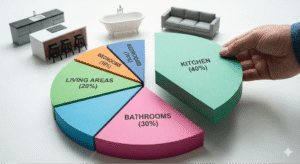
Budget Allocation is the strategic division of your total funds based on the usage intensity of each room.
It is the art of spending money where you will actually use it.
You should not spend the same amount on a guest bedroom as you do on a kitchen.
Here is a standard allocation model we use for Dubai apartments:
| Zone / Area | Allocation | Engineering Focus |
| Kitchen | 30–40% | The “engine” of the home. Capital goes into durable joinery, heat-resistant quartz/stone, and heavy-duty hardware (hinges/runners). |
| Bathrooms | 20–30% | High-traffic, wet zones. Investment is prioritized for MEP integrity, industrial-grade waterproofing, and sanitary ware. |
| Living Areas | ~20% | Aesthetic focus. Budget is allocated to high-impact flooring (tiles/wood) and ambient lighting profiles. |
| Bedrooms | 10–20% | Low-wear “dry” zones. Cost savings are achieved here by using standard paint finishes and simple carpentry. |
| Contingency | 10–15% | The safety net. Strictly reserved for unforeseen site conditions (e.g., hidden leaks, uneven sub-floors). |
Cost Transparency in Material Selection
Value Engineering is the method of substituting materials to reduce cost without sacrificing functionality or safety.
It is how we make high-end designs affordable.
Your choice of surface materials is the biggest variable in your budget.
If you choose Italian Statuario marble, your budget will spike.
If you choose a high-density porcelain slab with a marble print, you save 40% while gaining durability.
- Natural Stone: Porous, requires maintenance, expensive.
- Quartz/Porcelain: Non-porous, industrial-grade durability, cost-effective.
This is critical in a bathroom renovation in Dubai.
We often recommend high-quality ceramic tiles over natural stone for shower areas to prevent water absorption and humidity issues.
Hidden Costs You Must Not Ignore
Soft Costs are expenses that are not physically part of the building but are legally or logistically required to build it.
They are the invisible costs that catch homeowners off guard.
If you ignore these, your budget will fail.
Common soft costs in the UAE include:
- Demolition & Disposal: You have to pay to remove the old debris. Dubai Municipality charges for waste disposal at the landfill.
- Delivery & Logistics: Moving heavy tiles up to the 30th floor of a Marina tower requires manpower and elevator booking fees.
- Permits & NOCs: Approvals from the developer (Emaar, Nakheel, etc.) and the government cost money.
- Consultant Fees: Engineering drawings for MEP approval.
Always discuss these early with professionals.
Track Expenses as Project Progresses

Cost Control is the active monitoring of actual spending against the estimated budget throughout the project lifecycle.
It is the daily discipline of checking receipts against the plan.
Do not wait until the end of the project to check the total. Use a simple spreadsheet tracker. Update it every time you approve a purchase or sign a milestone payment.
This is especially vital in commercial interior design Dubai.
In office fit-outs, variations in data cabling or partition changes can escalate costs rapidly.
Establish “Approval Checkpoints” where work stops until the budget is verified.
Stop guessing and start controlling. Download our Engineering-Grade Budget Tracker here to catch cost overruns before they impact your wallet.
Conclusion
A successful renovation is 80% planning and 20% execution.
Preparing a budget is not about restricting your creativity.
It is about giving your creativity a realistic framework to exist in.
When you understand the costs of MEP, materials, and approvals, you make better decisions.
A professional interior design company in Dubai helps you navigate these numbers with engineering precision.
Ready to build a budget that works? Let’s calculate your scope!
You can also contact us for a feasibility assessment on:
Common Questions & Practical Answers
How do I know if my budget is realistic?
Compare your total budget against the square footage. If you are expecting a luxury finish for AED 100 per sq. ft., it is not realistic. Ask a contractor for the current “market rate per foot” for your desired finish level.
Which rooms cost the most to renovate?
Kitchens and bathrooms. These are “wet areas” requiring plumbing, waterproofing, gas, and electrical work, plus expensive cabinetry and stone. Bedrooms are significantly cheaper as they are mostly “dry” work.
Can designers help reduce costs?
Yes. Through “Value Engineering,” we can suggest alternative materials (like using laminate instead of veneer) that look similar but cost less. We also prevent costly mistakes like ordering the wrong size joinery.
Do budgets change during execution?
They shouldn’t, but they often do if the “Scope of Work” changes. If you decide to add a new electrical socket or change a wall color halfway through, this is a “Variation Order” and will add cost. Stick to the plan to stick to the budget.